
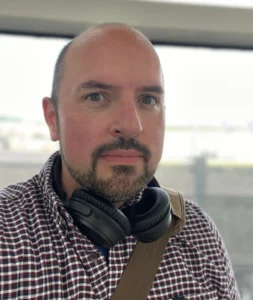
AJ Jefferies has been making animation since he was a kid, starting with hand-drawn Looney Tunes-style shorts before moving into 3D. After working as a CG generalist, he came to Animation Mentor to focus on character animation, which helped him push his work further and start creating his own films. Today, AJ produces original shorts like “DUCKS” alongside commercial and studio projects. We recently sat down with AJ to talk about his career path and advice for up and coming animators.
Start to a Career in Animation
Animation Mentor: Tell us about your animation journey. How did you get to where you are today?
AJ: Like 99.99% of animators, I got hooked on it at an early age and I used to spend my hours drawing and plotting my own Looney Tunes style shorts. Once we got a family computer with the capability to do some basic animation, I immediately started working digitally, first in 2D and then 3D and I haven’t really looked back.
Once I graduated college, I started working at a small, independent CG studio in my hometown, we worked on a LOT of wildly different projects, and that variety really helped me build up my skills as a generalist. I always knew I wanted to make my own films, but sadly character animation was one major area that I was lacking.
I enrolled in Animation Mentor in late 2007 and it really gave me the boost I needed to improve, as well as the flexibility to keep working on my day job. I now make and produce my own animated shorts and largely because of these, a big portion of my commercial work is creating animation.
Making Independent Shorts
Animation Mentor: Tell us about your latest short, “DUCKS.” What inspired you? What can you tell us about the process behind making an independent short?
AJ: The inspiration came from a lot of different avenues but the key catalyst for the film was a moment in real life. We’re fortunate enough to live in an area with a lot of nature reserves and we were taking our kids for a walk near a lake, teeming with ducks. At one point there were three ducks, all with their heads underwater and I quickly started coming up with weird things that could happen when they flip back over, just to make my kids laugh. When I got home, I couldn’t stop thinking about these ideas and eventually it evolved into “DUCKS”.
The process is a little chaotic as I have to fit these personal projects in and around paying work. It helps that I’m self-employed and work with the same software and tools for my day job, so it’s easy to quickly grab some time when waiting on clients for example.
Each film’s process is a little different but one unusual aspect for “DUCKS” was that I wrote out a full script, rather than boarding it. There were still a LOT of drawings but I kept making written notes to keep track of the ideas I was having and I realized that there was something very satisfying about having those concepts written down, it didn’t visually solidify them in the way sketching can and it allowed me to keep things free and exciting as I mapped out the film.
Once I had that script, I stood in front of our two kids and pitched the whole thing to them. They laughed REALLY hard at all of my dumb ideas, so that really fired me up to make it! From the practical side of things, as I handle every aspect of my films (although “DUCKS” is the first time I’ve worked with a musician/sound designer, the brilliant Megalithic Sound) there is a LOT to do, thankfully, I enjoy every aspect of the process, even the technical ones. Although, I often feel like I’m swapping my brain out for a different one depending on the task at hand!
Animation Mentor: Do you have any advice for animators wanting to make and release their own animated short?
AJ: I have so many thoughts about making your own films that I find it hard to narrow it down! I think the key, over-riding one is to make sure you are making something your truly want to make. It sounds obvious, but you need a lot of discipline to make a full short and I find that if you’re enthusiastic about the idea it really helps you knuckle down and, more importantly, you’ll enjoy the process! If you find yourself dreading working on it, then you know, deep-down that it’s not the right idea for you. There’s no shame in owning that and making something that does get you excited. Basically, make sure you’re making something that you genuinely want to see.
In terms of releasing, again a LOT of thoughts but I think some key advice would be to research how you are going to release it. If you want to send it out to festivals, check out their programs from previous years, attend them if you can and be honest with yourself about whether your film would be a good fit. Don’t just send it to every festival on FilmFreeway or similar platforms as this will not only cost you a huge amount of money but you’ll also have to deal with a YEAR of (possible) rejections, which could be soul destroying! Also be wary of festivals that run more than once a year and/or have way too many prize categories as many (though not all) are essentially scams. Getting a selection laurel always feels great but make sure you’d truly feel proud of that achievement by sending it to festivals you know and love.
A final piece of advice would be to make sure you have your film ready to submit. Again, this may sound obvious but as well as having the film in a variety of file formats, you will almost always need promotional stills, a poster, a written summary, director’s bio/photo, credit list, subtitles, a press kit… I met someone who runs an enormous festival who told me that, while being prepared won’t help a ‘bad’ film get selected, they have rejected good films because the director/producer weren’t organized enough to send them the files they needed in time.
Looking Back on a Career in Animation
Animation Mentor: In all the years you have been animating do any shots stand out as your most memorable?
AJ: Honestly, it’s hard to pick just one but one of my favourites is incredibly simple. In one of my other shorts, “PEAS”, there’s a moment where a sea of pea characters suddenly turn to look at the camera and when I first tested this effect it made me laugh SO hard! I didn’t feel like I’d animated it, I was just watching these little green weirdos take notice of the viewer and it really, really tickled me.
In another short, “H O R S E”, there’s a scene where the horse’s neck shoots out of frame and buckles when it slams into a bird. I could picture it so clearly in my mind, but it was a real technical challenge to achieve and I’m so glad I was able to get the image out of my brain and onto the screen eventually!
Experience as an Animation Mentor Student
Animation Mentor: How did Animation Mentor help prepare you for the animation industry?
AJ: In 2020, I was approached to work on a fantastic kids’ TV show called “StoryBots : Answer Time”. Up until this point, the majority of my animation work was either personal or directly for advertising clients, so this was my first experience where my working methods (and knowledge) would be tested with people with infinitely more experience. Thankfully, as I had learned how to animate through Animation Mentor, I was already working with industry standard practices and terminology, so I didn’t need to feel embarrassed about my process and I fully understood any and all feedback I had from the rest of the team. I was extremely grateful for this!
Advice for Animation Students
Animation Mentor: What advice do you have for current or future Animation Mentor students?
AJ: I know it’s a cliché but keep filling your heads and hearts with anything and everything that FEELS interesting to you, especially if it’s outside of animation. Every idea and decision you’ll put into your work is informed, consciously or not, by the things you feed your brain. If something scratches an itch in your head, go and investigate it! Even if it doesn’t feel relevant to animation. And to a similar end, work on creating things just for yourself. Write a short story, learn an instrument, sculpt, draw, cook an elaborate meal – as long as it appeals to you, the experience of taking that in will enrich and elevate your work and you’ll enjoy yourself; it’s a win-win!
Animation Mentor: Is there one thing every successful animator has in common? If so, what is it?
AJ: I would say enthusiasm. You can certainly be a paid-up, full-time animator and be cynical or detached from the process and get the job done but I guarantee that the best animators you’ll meet have unbridled passion for it. That excitement allows them to push things further, to want to share knowledge and support their peers. You also can’t force that enthusiasm, it’s genuine by default so if you don’t have it try and take a step back and figure out what does get you fired up.
You can connect with AJ on Instagram or Bluesky.
Want to be mentored by professional animators?
Follow your animation dreams just like AJ did by learning from pro animators! Get more information about Animation Mentor’s Character Animation Program or check out our Game Animation Program.