We’re covering the 12 Basic Principles of Animation one principle at a time! Next up is antici…pation! Learn what it means, why you need to know it, what it looks like, and how to use it to become the best animator you can be.
What is Anticipation?
Anticipation is a little workhorse of the 12 Basic Principles of Animation. It’s often easy to forget it in our work as we can concentrate on making nice poses, timing, smooth motion, etc…but without it our animation can end up looking robotic.
Some examples of anticipation:
• Entire body squashing down before jumping off a building
• The heel of the foot pressing down before a step
• Mouth compressing before opening to speak
• An eye blink before a head turn
As you can see from the list, the size of the anticipation does not matter. It can be broad or subtle.
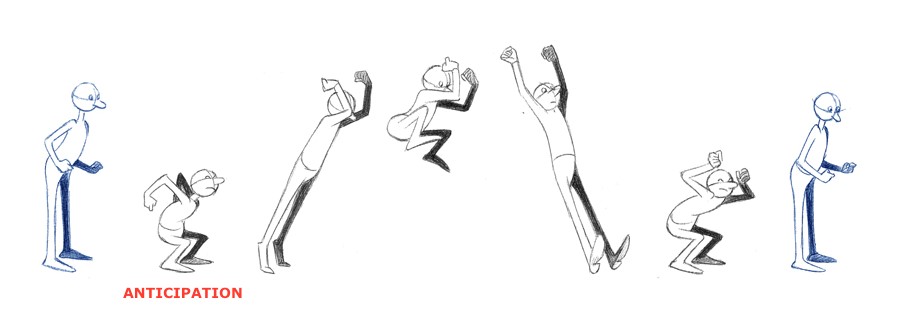
A broad form of anticipation as illustrated here by Richard Williams.
Why do animators need anticipation?
Let’s take a look at some clear examples of anticipation in this video. From a baseball player’s wind up at bat to the way your knees bend before a jump, anticipation is a crucial element in organic movement.
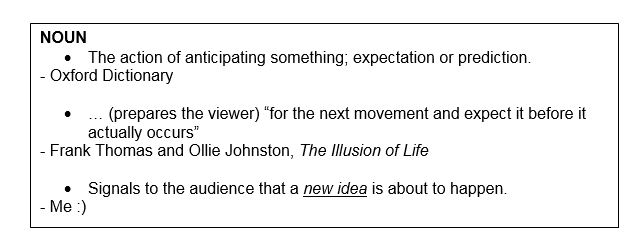
Anticipation is really something that tells the audience that a new idea is going to occur. It prepares them for it so when it happens they can enjoy it and not get caught off-guard. That’s not to say the nature of it can’t be a surprise. In fact, anticipation can actually help a surprise moment by helping build the suspense that something is about to happen (like in our Daffy Duck example below). The audience is then prepared to look for it instead of missing it.
The most common and easily seen examples of anticipation are in broad actions. You may have heard the classic definition of “moving in the opposite direction first”. It’s like a baseball batter’s wind up before the swing or leaning to the right before starting to move to the left.
However this is but one type of anticipation. To always use or think of it this way can lead to stock-looking animation that is basic and merely following known rules that work but lack that extra individuality and organic quality.
Let’s look at anticipation in cartoony animation. As you can see in this video, Daffy Duck’s reaction is funny, but it’s made even more effective when his face scrunches up small before widening in surprise. The anticipation makes the surprise even greater.
And for the video game industry where solid body mechanics are integral to player experience, anticipation is an even more important tool. In video games, players are often asked to respond to in-game characters or situations with only slight movement as a clue to their next step. Often these clues come in the form of anticipation—as an enemy raises their arm to swing a sword, the player has time to react and defend themselves.
How to master anticipation
In terms of physics, anticipation can help sell the build-up and storage of energy before initiating a new physical action, like the crouch pose in the Richard Williams example above. An important aspect to master is to make sure the timing, velocity, and broadness of the anticipation pose work in sync with the ensuing action. It’s almost like a math problem, the anticipation and the following action need to add up or it won’t look believable.
This mistake can crop up anywhere, but superhero animation is a common place. In order to make a superhero look superhuman often the direction is to “make it faster”. This in itself is ok. Where it breaks down is where the storing up of the energy in the anticipation is not sufficient to sell the subsequent faster-than-possible movement. Usually the anticipation is too small and/or too short in timing. A superhuman move is easier to accept if there is a proper anticipation before doing the hidden work of selling it.
Quick Tip: Finding Missing Anticipation
As we all know, it can be hard to be objective with our animation. We grow used to it, watching it thousands of times over and over, so we already know what’s going to happen. Our eye no longer needs anticipation to help. The consequence is that we don’t know when we’re leaving it out!
How can we catch this? One trick is to play your animation backwards. What was an anticipation now acts like a bit of the principle of “follow-through”.
An example would be the footfall on a dinosaur walk cycle. If we watch it backwards, the compression on the foot before it lifts off will look like an overlapping action after the foot lands. If it looks stiff because it’s not there, we have a clue that it might be a missing anticipation.
Unintended Anticipation
One final thing to watch for is a form of unintended anticipation. Usually this is when something starts to move before it should—like a head starting to rotate back before it’s hit by a punch.
The problem tends arise from setting keys for the head and the punch on the same frames rather than making sure you have enough breakdowns so that the head does not turn until the punch has actually landed.
Good luck, animators! Be sure to check back as we continue to our next principle: .
https://youtu.be/fLbu1oOzcjw Animator Nathaniel Seymour walks through animating a character gripping and releasing a prop using parent constraints and constraint keyframing in this recorded video tutorial. He builds a shot where a character pulls a giant match out of...
https://youtu.be/hAul5CtvQ_Y Jason Martinsen, a senior animator at Naughty Dog and an Animation Mentor mentor, walks through how to plan an acting test that stands out instead of blending into every other demo reel. He breaks down how to pick the right audio, find an...
https://youtu.be/L1OpbCdS7G0 Learn how stronger character development and drawing starts with truly observing the world around you in this free live-recorded workshop with character designer Stephen Silver. Stephen breaks down what artists should actually be looking...
https://youtu.be/bQZFBxiXxrc Animator Nathaniel Seymour walks through a full character and environment interaction using a personal short film project. He shows how a character reaches for a flower that's just out of reach, then decides to pull down the entire plant...
https://youtu.be/j0slMAHClkE In this recorded video tutorial, animator and Animation Mentor mentor Nicole Gregory breaks down MetaHuman Creator, Epic's tool for building realistic digital characters, and shows the full path from a blank character template to a rigged,...
https://youtu.be/jzuxAmadcm8 Take your animation beyond the blocking stage and into a truly polished performance. In this recorded workshop, mentor and Framestore Animation Supervisor Arslan Elver breaks down how to refine spacing, clean up arcs, and elevate secondary...
https://www.youtube.com/watch?v=BJn_Jv-XgZg Learn the essentials of what makes a demo reel truly stand out in this focused workshop with DreamWorks Head of Character Animation Sean Sexton. You’ll walk through the 5 key things every strong show reel needs, along with...
https://youtu.be/Hh_rgOsFMwM You’ve spent countless hours animating your best shots but translating them into a demo reel that will make your work shine above the rest isn’t always a clear task. In this free workshop, Disney Animation Supervisor Ere Santos gives...
The field of animation is becoming more popular with each passing year. As the demand for unique and entertaining content grows, the demand for skilled animators is also on the rise. But there’s a catch: this sector is also remarkably competitive! That’s especially...
Just a few of the films on Shawn Kelly's IMDb page Shawn Kelly, Lead Animator at Industrial Light & Magic (ILM) and Animation Mentor Co-Founder educates us on why you need more creature animation in your demo reel and reminds us that we are all animators. Sit back,...